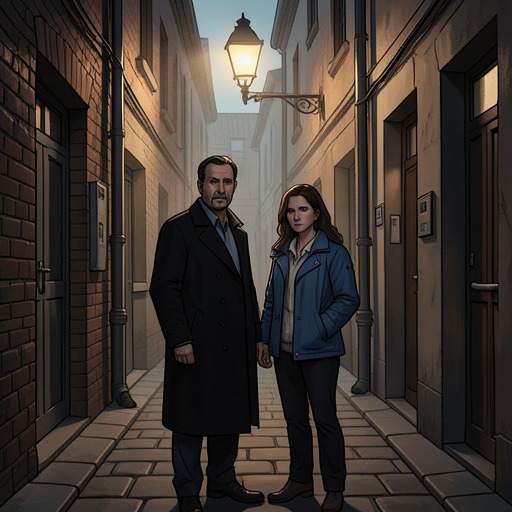
Hugo Nestor
The SonHugo Nestor is the principal drugs and human-trafficking operator in Oslo, a criminal boss whose apparent respectability masks a system of coercion and institutional corruption. His power rests not only on his own authority but on a web of accomplices: he recruits people with useful skills, exploits prison and police contacts, moves drugs through established routes, and launders proceeds through legitimate businesses. His eventual death at the hands of Sonny Lofthus turns the violence he directed against others back upon him.
Identity and Public Face
Nestor is widely known as the Ukrainian, but the police file Simon Kefas has seen describes a different history: Nestor was born and raised in Florø, came from a fishing family, and was originally named Hansen. His only time abroad, according to that file, was a brief, unfinished economics course in Lund, Sweden. The source of his conspicuous accent is unknown. The discrepancy between his assumed identity and documented background makes the alias part of his performance of authority rather than reliable biography.
That performance is supported by money, presentation, and access. Nestor travels in a limousine with tinted windows and a driver, and Simon recognizes the car as one of the few vehicles of that kind in Oslo. Nestor appears in a blue blazer with gold buttons and presents himself as jovial and composed. His manners and polished surroundings coexist with racism: in conversation with Simon, he voices antisemitic and anti-Slavic views while claiming a distinction between prejudice against groups and individuals. The respectable surface does not soften the brutality of his operation; it helps him conduct business among wealthy patrons and people with institutional influence.
The police regard him as Oslo’s most important drugs and human-trafficking operator, yet he has never been charged or convicted. He is suspected repeatedly but remains difficult to prosecute, described in the police file as intelligent and careful. When Simon challenges him over rumors that Nestor’s associates had arranged the prison chaplain’s death, Nestor turns the absence of a reliable witness into a rebuke: without admissible evidence, Simon has no arrest to make. His impunity is thus practical as well as theatrical, founded on the gap between what is widely suspected and what can be proved in court.
Criminal Network and Methods
Nestor’s organization links trafficking, drug distribution, violence, and influence over supposedly separate institutions. He recruits Johannes Halden after Johannes returns to crime following his release from prison. Heroin from northern Thailand is carried by truck along the route through Turkey and the Balkans, distributed to Scandinavian countries after reaching Germany, and driven on the final leg by Johannes. The arrangement gives Nestor access to experienced transporters while placing each participant inside a larger supply chain.
His authority is enforced through calculated punishment. Kalle Farrisen, who works for Nestor, once fell asleep while guarding heroin worth 300,000 kroner intended for sale on Nestor’s behalf. Nestor told Kalle that the boss had allowed him to choose between losing his thumbs and losing his eyelids. Kalle chose his eyelids. Although Nestor later gave him money for a taxi to the hospital and Kalle eventually regained his job, the apparent provision of help follows, rather than cancels, the threat: an injury becomes a lasting warning about the price of carelessness. Kalle’s return to work after he retaliates against a man who mocks him shows how the organization can reward resourcefulness while keeping its members within a system governed by fear.
Nestor also uses specialists by making their talents dependent on him. Rover had supplied and modified guns for a biker gang and was skilled enough to attract notice. While Rover was serving his first sentence, Nestor took him under his wing and ensured that Rover would work for him rather than for the gang or rival customers. Nestor paid him more in a few months than Rover could have expected to earn in a lifetime repairing motorcycles, but demanded too much in return. The arrangement converts professional skill into a source of leverage: money opens the door, then obligation and coercion keep it open.
Human trafficking is another core part of Nestor’s business. Rover recounts that Nestor kept nine girls in a cage in Enerhaugen, including young women from Eastern Europe and Asia. One of them, called Minsk by Nestor, escaped as far as Tøyen Park before one of the Argentine mastiffs Nestor used caught her. Nestor ordered Rover to kill her as a lesson to the other girls and as proof of Rover’s loyalty. The episode exposes the function of violence within the organization: it is used not only to control an individual but to terrorize a captive group and bind an accomplice to the crime.
The same business operates through social settings that blur criminal and respectable worlds. At Vermont, a restaurant, bar, and nightclub frequented by rich patrons, financiers, entertainers, and successful criminals, Nestor and his associates occupy a cordoned-off table. The venue offers both a place to conduct business and a setting in which the police’s presence need not automatically draw attention. When a visitor requests an Asian girl for a client willing to pay any price, Nestor treats the request as ordinary business and asks whether the man looks like a police officer. The exchange shows how trafficking requests can pass through the same social spaces as conventional wealth and entertainment.
Corruption and Institutional Reach
Nestor’s organization reaches into the prison system and police force. After Simon’s investigation points toward Nestor, Simon and Kari Adel confront Lars Gilberg, who admits that the men responsible for an assault were Nestor’s. Gilberg hesitates to say more because he fears what Nestor does to people who betray him. Simon warns that his name will appear in interview logs at police headquarters, giving the account an additional danger: even a formal police interview could expose a witness to the criminal network.
Simon recalls longstanding rumors that a police mole leaked information to the person controlling much of Oslo’s drug and sex-trafficking business. The rumors had circulated for years without proof that either the mole or the alleged crime boss existed. Ab Lofthus’s diary later clarifies that the conspiracy was not the work of one corrupt officer but of two: the partners reasoned that one would always have an alibi while the other was active, making them harder to suspect. They had turned a blind eye to drugs, human trafficking, and even murder. The diary also describes their anonymous communications and stolen computers, alongside the Twin’s effort to advance one of them within the police. Nestor’s power therefore belongs to a broader criminal arrangement in which corrupt officers, prison contacts, and traffickers help shield one another.
The network also connects to business and money laundering. Simon tells Iver Iversen that Iversen Property did business with the Twin, laundering proceeds from drugs and trafficking in return for fictitious losses that generated tax savings amounting to hundreds of millions of kroner. Iver denies knowing the Twin, but Simon says he has evidence of their collaboration. The accusation reveals how the criminal operation can convert illicit proceeds into apparent commercial transactions, extending its reach beyond street-level trafficking and direct intimidation.
Nestor’s handling of witnesses and potential threats is consistent with this wider system. Johannes, who had become a confidential informant, remembers that Nestor spoke to his boss about getting rid of a policeman named Lofthus before he ruined their operation. Johannes warned Ab, who suspected the mole and understood that other officers were compromised. Ab chose not to involve others and made Johannes swear to keep the information secret. Nestor’s threat therefore helps explain the silence surrounding Ab’s danger, while the promise of secrecy leaves the truth undisclosed until Johannes finally tells Sonny.
Exposure and Death
Nestor’s violence toward trafficking victims becomes one of the facts Sonny confronts directly. Sonny asks Fidel Lae whether it is acceptable for a dog to bite a young girl in the face when she tries to escape slavery and whether such conduct should be punished. Fidel initially does not understand what Sonny is referring to. Sonny then identifies the owner as Hugo Nestor and points out that Nestor had bought several dogs from Fidel, which could be used for such purposes. Nestor is no longer merely the name attached to rumors: Sonny connects him to the treatment of the captive girls and to the animals used against them.
Sonny ultimately abducts Nestor from a meeting at Vermont. Nestor realizes that he has been drugged and reaches for a knife, but he takes hold of the wrong leg before being struck unconscious. He wakes bound inside a large wheeled case, is moved without his captor answering his attempts to bargain, and is taken to Fidel’s enclosure. The destination turns Nestor’s own method of terror into the means of his punishment: the Argentine mastiffs he had used against captive women are now in the enclosure with him.
At the enclosure, Sonny unlocks the gate, puts a hand on Nestor’s head as if blessing him, and pushes him inside. Fidel watches as the dogs attack Nestor. Sonny turns away, his shoulders shaking as though he is crying. The scene ends Nestor’s ability to command others through fear, but it does so through vigilante punishment rather than a court judgment. His death does not resolve the institutional corruption that protected his enterprise; it makes the difference between the criminal network’s violence and lawful accountability impossible to ignore.
Narrative Role and Significance
Nestor functions as both an individual antagonist and the visible center of a dispersed system. He can be named as the suspected boss, yet his influence is exercised through recruiters, transporters, prison employees, police moles, business arrangements, and those who fear being recorded or exposed. The recurring difficulty is not simply identifying a powerful criminal but proving what the network has arranged while its members protect one another and its victims are kept vulnerable.
His character is also defined by reversals between appearance and consequence. The polished blazer, limousine, champagne, and fashionable restaurant table signify access to respectable society; the trafficking cages, threatened witnesses, coerced workers, and organized violence disclose what that access serves. His uncharged status underscores how the law can know a great deal about a criminal’s reputation and still fail to bring him to trial. When Sonny places him among the dogs, the ending answers Nestor’s use of terror with a private act of retribution, leaving the reader with the unresolved distinction between punishment and justice.